
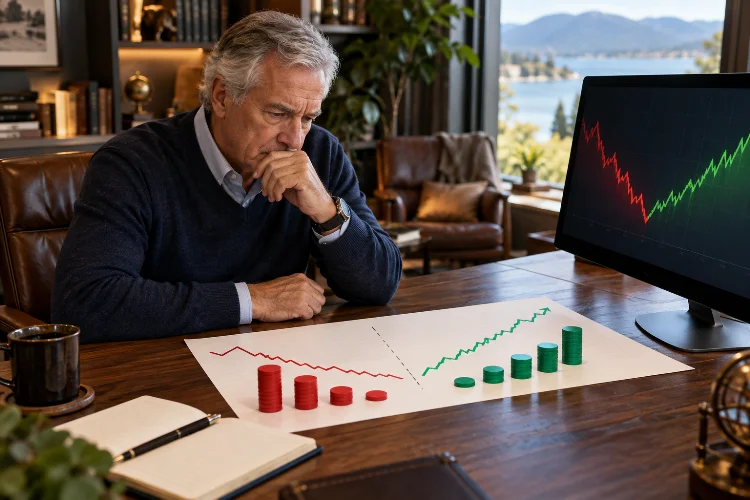
Retirement investing has an uncomfortable twist: earning a good average return does not always guarantee that your money will last. The order in which those returns arrive can be just as important as the average itself.
A sharp market decline during the first few years of retirement can be especially damaging because you are withdrawing money while your investments are falling. Those withdrawals leave fewer assets available to participate when markets eventually recover.
This is where sequence risk management for more reliable retirement withdrawals becomes important. Instead of assuming markets will deliver smooth returns, retirees can prepare for periods when stocks fall, inflation rises, or portfolio values temporarily shrink.
The goal is not to predict the next recession or avoid every investment loss. It is to create enough flexiblity that poor returns early in retirement do not permanently derail decades of financial planning.
With the right withdrawal rules, asset mix, and spending reserves, retirees can make their income considerably more resilient.
What Is Sequence-of-Returns Risk?
Sequence-of-returns risk describes the danger created when investment losses occur at an unfavorable time while money is being withdrawn from a portfolio.
For someone still working and regularly contributing, a market decline can actually provide opportunities to buy investments at lower prices. Retirees face the opposite situation because they may need to sell assets to pay living expenses.
Charles Schwab explains that early retirement losses can reduce portfolio longevity because retirees may have to sell more investments at depressed prices to generate the same amount of cash. That also leaves fewer assets available for a future recovery.
Consider two retirees who both start with $1 million and eventually experience similar long-term returns. One encounters strong markets during the first decade, while the other suffers several weak years immediately after retiring.
Even though their average returns might eventually look similar, their final financial outcomes can be dramatically different.
Why Early Retirement Years Matter So Much
Sequence risk is often associated with one sudden stock market crash, but the bigger concern may be a prolonged period of weak real returns.
Research discussed by retirement specialist Michael Kitces shows that returns during roughly the first decade of retirement have a particularly strong relationship with sustainable withdrawal rates.
A bad first year alone does not automatically destroy a retirement plan, but years of disappointing returns combined with continuous withdrawals can gradually weaken the portfolio.
This creates what might be called a retirement danger zone.
Suppose a $1 million portoflio falls to $800,000 while the retiree still needs $50,000 for annual expenses. That withdrawal now represents 6.25% of the remaining portfolio rather than 5%.
Another decline the following year increases the pressure further.
The problem is not simply losing money. It is losing money while simultaneously removing capital that might otherwise benefit from the recovery.
Keep Flexible Spending in Your Retirement Plan
One of the simplest ways to reduce sequence risk is to avoid treating every dollar of retirement spending as mandatory.
Housing, basic food, insurance, utilities, and healthcare may be difficult to reduce. Travel, restaurants, entertainment, gifts, vehicle purchases, and home renovations generally provide more flexibility.
If markets fall significantly, temporarily trimming discretionary spending can reduce how much needs to be withdrawn from investments.
Vanguard highlights dynamic spending as one way to address sequence risk. Instead of withdrawing exactly the same inflation-adjusted amount each year, retirees can establish spending floors and ceilings. Withdrawals can fall modestly after weak investment years and increase when portfolio performance is strong.
That does not mean cancelling your entire lifestyle because stocks fall 10%.
Even relatively small adjustments can help. Vanguard’s retirement-planning research notes that modest spending reductions during down periods can materially improve portfolio sustainability under certain assumptions.
Build a Cash Buffer Before You Need It
Selling stocks during a bear market is one of the situations sequence risk management tries to avoid.
A cash reserve can create breathing room.
Some retirees maintain enough cash or very short-term fixed-income investments to cover a portion of upcoming portfolio withdrawals. When equities fall sharply, living expenses can temporarily come from those safer assets instead of forcing stock sales.
Fidelity identifies cash, cash equivalents, short-term bond ladders, and other income-producing assets as potential ways to reduce the need to sell investments during downturns.
However, holding excessive cash creates another problem.
Cash generally offers lower long-term growth potential than equities. Keeping five or ten years of expenses entirely in cash could reduce the portfolio’s ability to keep up with decades of inflation.
The objective is therefore balnce – not maximum safety at all costs.
Use Asset Allocation to Reduce Withdrawal Pressure
A retirement portfolio does not necessarily need to become extremely conservative, but asset allocation matters when withdrawals begin.
A portfolio heavily concentrated in stocks can experience large fluctuations. Those fluctuations become more dangerous when income must be withdrawn at the same time.
Adding high-quality bonds or other lower-volatility investments may create alternative sources of retirement cash during equity downturns.
Fidelity notes that portfolios weighted heavily toward equities can face greater sequence risk because of their higher volatility. A diversified allocation combining income-producing and growth-oriented assets may help retirees manage that exposure.
Still, eliminating stocks completely may create longevity and inflation risks.
Someone retiring at 60 could easily need their portfolio to support spending for 30 years or longer. Growth assets remain important because retirement is usually a long investment horizon, not a short liquidation period.
Avoid Automatic Selling During Down Markets
Retirement withdrawals should ideally have a funding hierarchy.
Imagine the stock market falls 25%. Instead of selling equity investments immediately, a retiree might first use available cash, bond maturities, dividends, interest income, or other income sources.
Fidelity provides a striking hypothetical illustration of sequence risk: two retirees start with $1 million and experience the same series of returns in opposite orders.
In the scenario where poor returns arrive early, the portfolio is depleted by year 27, while the portfolio experiencing positive returns first retains substantial assets after 30 years.
The example is hypothetical, but the lesson is practical.
Having several potential sources for withdrawals gives retirees choices. Without that flexibility, market prices effectively determine when investments must be sold.
Consider Dynamic Withdrawal Guardrails
Another approach is to establish predefined withdrawal guardrails.
Instead of making emotional decisions during market turbulence, the retiree sets rules in advance.
For example, the plan could allow normal withdrawals while the portfolio remains within an acceptable range. If the withdrawal rate rises beyond a predefined threshold after market losses, spending might temporarily decline.
If strong investment performance pushes the rate well below the target range, spending can increase.
This approach transforms retirement income from a fixed number into a controlled range.
Guardrails can also reduce the temptation to either overspend during bull markets or panic during corrections. However, the thresholds should reflect the retiree’s essential expenses, guaranteed income sources, age, investment allocation, and willingness to adjust lifestyle spending.
Coordinate Portfolio Income With Guaranteed Income
Sequence risk becomes easier to manage when investments are not responsible for every household expense.
Social Security, pensions, annuity income, or other predictable sources can cover part of essential spending. Portfolio withdrawals can then focus more heavily on flexible expenses.
Imagine a household needing $70,000 annually but receiving $45,000 from Social Security and pensions.
Only $25,000 needs to come from investments.
If markets decline, perhaps $10,000 of that amount represents discretionary spending that could temporarily be reduced. The household therefore has much more flexibility than someone relying on investments for the full $70,000.
This income layering can make retirement withdrawals more consistant and reduce pressure to sell assets during unfavorable markets.
Review Sequence Risk Every Year
Sequence risk management is not something you set up once on retirement day and then forget.
Portfolio values change. Inflation changes. Spending priorities change. Guaranteed income may begin at different ages, and healthcare costs can become more important later.
A yearly retirement review should examine your current withdrawal rate, asset allocation, cash reserves, expected expenses, tax situation, and portfolio performance.
The first several years of retirement deserve particular attention because this is when poor market conditions can have the greatest long-term impact.
The goal is not constant adjustment. It is early detection.
Small spending or portfolio changes made before financial pressure becomes severe can be much easier than attempting a major rescue after years of excessive withdrawals.
Sequence risk can make two otherwise similar retirement portfolios produce dramatically different outcomes. The danger becomes greatest when poor investment returns arrive early while regular withdrawals continue reducing the assets available for recovery.
Effective sequence risk management combines several defenses: flexible spending, sensible asset allocation, cash reserves, diversified income sources, and withdrawal guardrails. None of these techniques can eliminate market volatility, but together they can reduce the damage caused by bad timing.
Before retirement, test how your income plan might perform through several difficult market years – not just average returns. Review the strategy regularly and adjust before problems become serious.
If your portfolio, taxes, or income sources are complex, consider working with a qualified financial professional to build a withdrawal plan designed for both good markets and bad ones.